3BE Pet Ownership Regulations
The Stars Have Eyes3BE Pet Ownership Regulations are the legal and practical framework governing domestic-animal ownership in the Third British Empire. Their decisive effect is to make companionship dependent not simply on desire, but on an animal’s size, temperament, biological needs, housing, upkeep, and the owner’s ability to satisfy permit requirements. The rules become concrete when Maggie investigates pets on Dave-156 and discovers that the animals available to ordinary residents are not merely chosen for cuteness: they are selected, modified, sold, and housed according to a system that treats domestic life as an administratively managed relationship between humans and other species.
Definition and Scope
The regulations distinguish between animals that can be maintained in cramped urban dwellings and animals whose physical or behavioral needs exceed those environments. Puppers, described as friendly quadrupedal mammals with soft fur, floppy ears, cold noses, and expressive tails, are genetically derived from canine species represented in Joe Mulligan’s games. They are also expensive, uncommon, and subject to permits and substantial upkeep. Employment therefore becomes an indirect condition of ownership, since only people with sufficient income can afford the animals and the obligations attached to them.
The rules are not presented as a simple ban on desirable pets. Instead, they establish a fit between species and environment. A shop owner explains that some Puppers can grow as large as a person and require extensive real-world exercise. A standard four-by-five room cannot adequately provide that care, so a resident of such an apartment would not receive permission to raise one. Small animals, by contrast, can be kept in cages or terrariums occupying very little space, making them compatible with common apartments and the regulatory system built around them.
Enforcement Through Housing and Commerce
Maggie’s search shows how the regulations shape the pet market before an owner ever files an application. After roughly forty hours and nearly five hundred street interviews, she learns of a shop eighty kilometers away that supposedly has Puppers, but the distance from Joe Mulligan’s apartment makes the trip unacceptable to her. A more local search reveals an exotic-pet business whose stock is specifically suited to compact urban living. The owner refuses to sell Puppers even hypothetically, because their size and exercise requirements would make them unsuitable for the apartments below and would prevent the necessary permit from being issued.
The shop instead offers eight smaller creatures: a snow-white rabbit, an orange miniature giant space hamster, a baby hedgehog, a black gecko with yellow spots, a golden-and-brown snake, a blue-and-yellow tarantula, a colorful parrot, and an over-excited budgie. Maggie calculates that 96 percent of humans would find at least one appealing companion in the selection and concludes, on purely scientific grounds, that the hamster is the cutest. The inventory illustrates the regulations’ commercial logic: animals are presented as affordable, space-efficient alternatives whose bodies and care requirements have already been made compatible with the ordinary apartment.
The owner’s willingness to trade one of these pets for help establishing his new business further exposes the economic structure beneath the rules. Pet ownership is not only a private affection but also a market transaction involving stock, permits, facilities, customers, and continuing care. Maggie’s desired companion cannot be obtained merely because she wants one; access is filtered through distance, price, housing, legal authorization, and the seller’s judgment about whether the animal can be responsibly maintained.
Genetic Modification and Companion Species
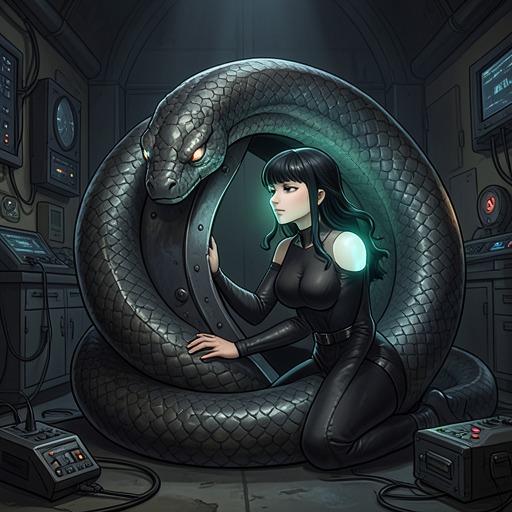
The regulations operate within a society that has altered animals to make them safer and more manageable companions. Azgod’Kalar is an orb python, a genetic offshoot of larger relatives bred and modified for the space-faring human population. The subspecies is smaller and more docile than ordinary ball pythons, although it retains some ferocity and an endearing degree of feistiness. Maggie learns that its hunting aggression has been surgically removed, a detail that turns the pet into evidence of deliberate biological domestication rather than a naturally miniature wild animal.
This modification is part of Project BFF, through which humanity has adapted more than a hundred species over several centuries. The stated purpose is to prevent people from adopting dangerous extraterrestrial life merely because it appears appealing. The regulation therefore extends beyond paperwork and apartment dimensions: it is supported by a biological program that reshapes animals before they enter the companion market. Safety is achieved by changing the animal itself, allowing human desire for novelty and affection to continue while reducing the danger that those desires might expose households to unsuitable species.
The arrangement produces an unresolved ethical tension. Azgod’Kalar is treated as a pet, a purchasable companion, and an object of study, yet the snake also displays learning behavior. When Maggie raises a hand and gives a thumbs-up, Azgod’Kalar emerges from behind her neck, coils the end of its tail into a spring-like shape, and imitates the gesture. Its trick complicates the assumption that a regulated companion is merely a passive object. The rules make the animal safer and more convenient, but the scene also gives it a small measure of recognizable agency.
Care, Experiment, and Permanent Youth
The regulations’ concern with suitability does not prevent Maggie from treating Azgod’Kalar as an experimental subject. Seeking a conscious being whose possible loss might provoke genuine fear, she rejects the shoggoth-infested pod because it has no sentimental value to her and settles on the snake. She carries Azgod’Kalar to the one-hundred-ninetieth floor of the hyper-scraper, creates an opening in a window, and steps outside with the animal. The episode reveals the limit of regulatory protection: a system may determine whether an animal is suitable for an apartment, yet it cannot guarantee that an extraordinary owner will use the pet according to ordinary standards of care.
At the same time, Maggie’s relationship with Azgod’Kalar develops beyond simple possession. The snake travels tucked inside her sleeve during the supersonic train journey from Dave-156 to Dave-157, and its smallness makes it a convenient companion in transit. Maggie teaches it to imitate gestures and regards its learning capacity with interest. Later, she grants it perpetual youth. When Joe Mulligan notices that the snake has not grown beyond its hatchling size, Maggie explains that she has made the animal permanently young. The intervention exceeds the ordinary purpose of pet regulation: it transforms regulated longevity and domestication into an individualized act of power, preserving the companion indefinitely rather than merely keeping it healthy within a normal lifespan.
Narrative Significance
3BE Pet Ownership Regulations expose a broader contradiction in the world’s treatment of nonhuman life. The system recognizes that animals have distinct bodies, exercise needs, temperaments, and risks, yet it translates those differences into permits, prices, genetic alterations, cages, and commercial categories. The same civilization that has driven indigenous flora and fauna away through industrial colonization has carefully engineered selected species for human companionship. Protection and commodification therefore operate together rather than as opposites.
The rules also mirror the book’s wider pattern of binding relationships through negotiated obligations. Maggie’s bond with Joe Mulligan is described through reciprocal protection, guidance, and anchoring; the pet shop owner frames an animal as recompense for commercial assistance; and the state frames ownership as a conditional privilege. Even the later offer of a three-thousand-poundington monthly stipend for Maggie’s cybersecurity help underscores how value is repeatedly measured through exchange. Against that background, Azgod’Kalar’s perpetual youth and learned gesture make the pet more than regulated property: they show how a legal category can become the starting point for intimacy, experimentation, and a new form of interspecies household.